Personalized Learning
 “As we strive to position our Catholic schools for greater academic excellence and long term financial stability, strategic planning is an essential tool. While we need to maintain the essence and heart of Catholic education, we must also adopt the best of modern practice and pedagogy, with a spirit of innovation that can help us to best serve the young people entrusted to our care.
One of the major innovations that we have embraced in our educational mission is the use of “personalized blended learning.” Simply put, this model blends traditional classroom instruction with an online diagnostic set of tools that allow teachers to understand the mechanics of how each student learns (personalized approach), allowing the teacher to give direct assistance in those areas that a student may find challenging, all the while allowing the same student to excel in areas that he or she can understand easily.
In the past, traditional classroom instruction tried to engage all students. However, what actually happened was that students who easily mastered the materials being taught got bored and those who could not understand were left behind. Web-based diagnostic programming now allows teachers to know exactly what a student may understand well, what is difficult for the same student and pin points the materials needed to help the student to overcome the difficulties. This innovation has been adopted throughout the country and we are introducing it into our schools with the hope of unlocking the full potential of every student. An image comes to mind that can simply explain this innovation. If we are driving on a highway and we encounter potholes, our travel is slowed and difficult. If the potholes are filled, then we can travel as fast as the law allows. So too with education, for if the individual challenges or difficulties experienced by students are likened to potholes, then the more we can see them and “fill them in” for each student, the faster he or she can learn.
Change is never easy. We live in a world where change occurs at a faster and faster rate. True innovation in Catholic education does not make change for change sake but does so for the good of the students entrusted to our care.” – Bishop Frank J. Caggiano
Developing Learners
Your students are guided by teachers to gradually assume responsibility for their own learning and development. Teachers work individually with your child to identify, document, and develop their strengths as learners and children of God. Students meet with teachers to set and track progress towards achieving their own personal and learning goals, increasing their capacity for independent and self-guided learning over time.
Flexible Learning Environment
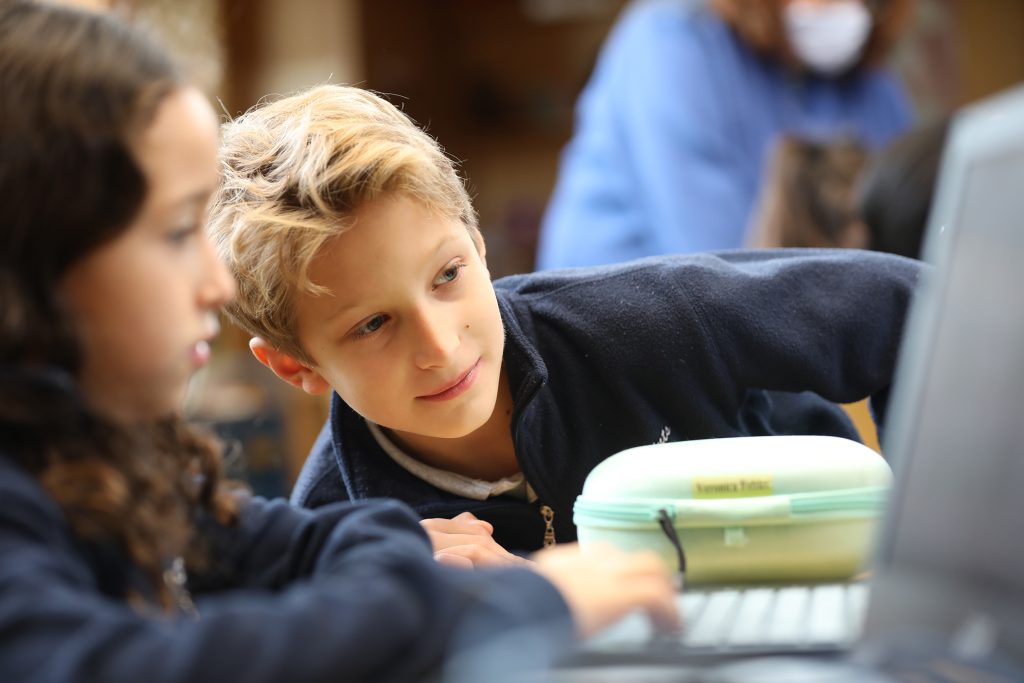
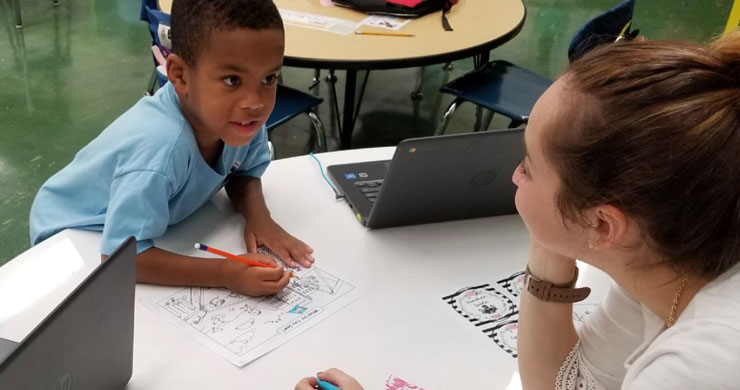
Students learn through multiple instructional strategies, blending traditional teacher-led instruction, peer collaboration, and individual learning to help each student realize their maximum potential. Flexible instructional models allow teachers to spend more time working with your child individually and in small groups while students spend part of their time learning individually, in groups, and with digital learning platforms. Through this model your child is constantly learning and getting the individualized attention they deserve.
One flexible learning model commonly found in your school is the center-rotation model. In this model, teachers give a whole-group mini-lesson followed by teacher-designed centers students rotate through, working individually or in small groups on standards-based learning tasks. In one center, students meet with the teacher individually or in small groups to receive individualized instruction, review learning progress and performance, and set new goals.
Innovation Zones
Students collaborate and create in an environment built around a STEM (Science, Technology, Engineering, and Math) curriculum with focused activities including robotics, coding, design, visual and digital media, and engineering.
In the innovation zone, your child is using computer-assisted design software, fabrication tools, programming and controlling robots, producing audio and video, and learning about electrical engineering. Students also learn how to stay safe online while being a moral digital and online citizen.
Learn More About Our Personalized Catholic School Education
At Diocese of Bridgeport Catholic Schools, we are committed to providing a personalized, faith-filled education that nurtures the academic, spiritual, and personal growth of every student. Guided by dedicated teachers and supported by innovative educational technology, our schools create engaging learning environments where students are challenged, supported, and empowered to reach their full potential.
By incorporating modern learning platforms and data-driven instructional tools, our educators can identify individual strengths and areas for growth, allowing them to tailor instruction to meet the unique needs of each learner. Whether through collaborative projects, hands-on experiences, or individualized learning opportunities, students are encouraged to develop critical thinking skills, creativity, confidence, and a lifelong love of learning.
With Catholic schools located throughout Fairfield County in Bethel, Bridgeport, Danbury, Fairfield, Greenwich, Newtown, Norwalk, Ridgefield, Stamford, Stratford, and Trumbull, families have access to exceptional academic programs rooted in faith, values, and service.
Discover the difference a Catholic education can make. Visit Our Schools page to learn more about our schools, schedule a visit, or begin the enrollment process. We look forward to welcoming your family to our community.
If you have any questions about Personalized Learning, please contact Sarah Beck, Personalized Learning Director, S.Beck@diobpt.org.